Get Started
Accessing Permission Editor
The Customfield Editor for Jira enables normal users to edit options of a customfield without beeing part of the jira-administrators group. Therefore the Jira administrator needs to grant permissions on customfields via the Permission Editor to normal users. To access the Permission Editor, follow the steps below:
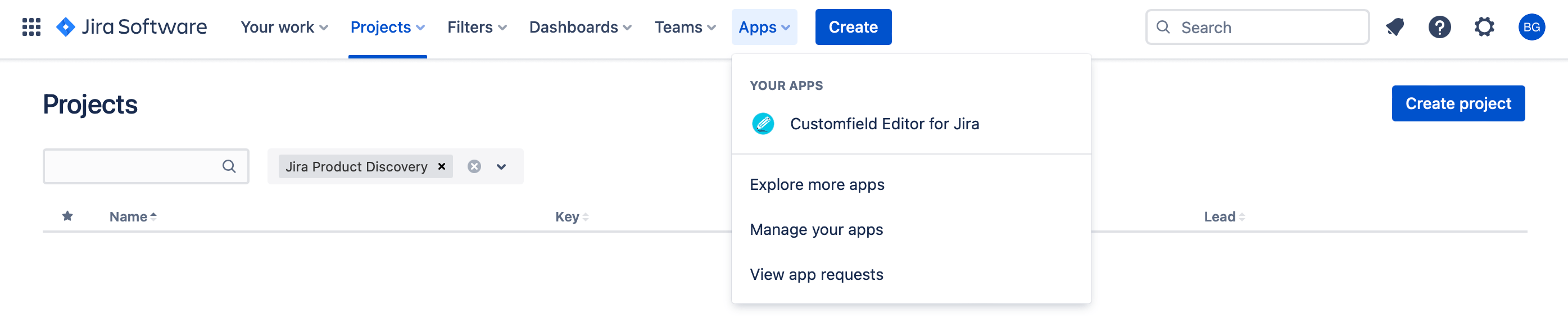
Select in the Jira top navigation bar Apps > Customfield Editor for Jira.
The App page will appear and show you a list of customfields.
Now you can click on the
 usergroup icon to open the Permission Editor slider.

Note: For all actions described in this Administrator Guide you need Jira administrator privileges. Normal users will not see the
Supported Field Types
Currently the app supports the following Jira built-in field types:
Select List (single choice) | |
Select List (cascading) | |
Select List (multiple choices) | |
Checkboxes | |
Radio Buttons |
Rate Limits
Since the Cloud app is written in Forge we have to work with limited execution time and limits on how many API request we can make. Therefore the following limits are currently in place to avoid timeouts and slow response times of the App:
User view:
- list customfields:
- pagination without filter: Maximum number of 150 fields will be displayed. (=max 3 API request per page, ordered by field name)
- pagination with filter: Maximum number of 150 fields will be displayed. (=max 3 API request per page, ordered by field name, filter via memory)
- list contexts of field:
- pagination without filter: max 300 contexts will be displayed. (=max 3 API request per page, order implicit)
- pagination with filter: max 300 contexts will be displayed. (=max 3 API requests, order implicit, filter in memory)
- list options of context:
- Maximum number of 1,000 options displayed per context. (=max 10 API requests, ordered by internal order)
- Note that this applies to fields and contexts the user has permissions granted to
Admin view:
- list customfields:
- pagination without filter: All fields will be displayed. (=1 API request per page, ordered by field name)
- pagination with filter: All fields will be displayed. (=1 API request per page, ordered by field name, filter via API)
- list contexts of field:
- pagination without filter: All contexts will be displayed. (=1 API request per page, order implicit)
- pagination with filter: max 300 contexts will be displayed. (=max 3 API requests, order implicit, filter in memory)
- list options of context:
- Maximum number of 1,000 options displayed per context. (=max 10 API requests, ordered by internal order)
We plan to increase this limit once we see there are no performance or rate limit problems in production. But keep in mind that we can also lower these limits anytime should we see degraded performance in production.
Note: Should you experience problems with these limits, please reach out to our support and we try to work out a solution.
 Data Center